
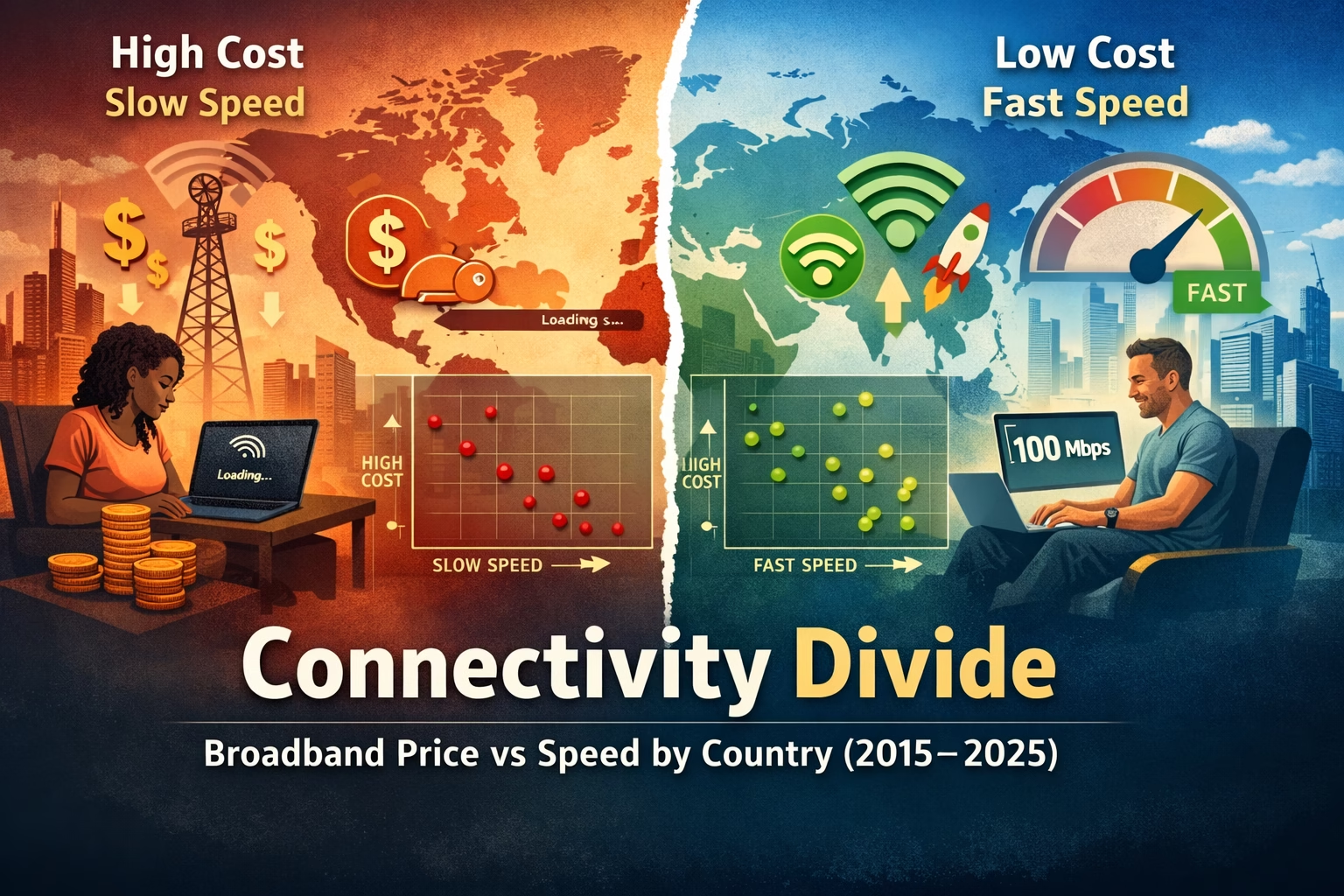
The connectivity divide is not just about whether you can get online. It’s about what you pay, what you get, and whether the service is good enough to work, learn, and build a business. From 2015 to 2025, broadband speed has climbed fast in many places, but affordability has not improved at the same pace everywhere. In practical terms, a “cheap” plan can still be expensive once you measure it against local income, and a “fast” network can still feel out of reach if pricing or competition keeps people stuck on slower tiers.
This article compares internet price and broadband speed using the most defensible global affordability benchmarks available, then explains why the gaps persist. You’ll see where affordability is structurally better, where it remains a luxury, and what policy levers (competition, wholesale access, spectrum, and build-out rules) tend to move the needle.
AI summary
- Snippet: Broadband speed isn’t equal: compare internet price vs speed by country using ITU affordability baskets and speed benchmarks—who’s ahead, who’s stuck.
- What to watch: A useful way to compare countries is to separate two questions: (1) How affordable is entry-level fixed broadband relative to income? and (2) How much real-world performance do people get once they are connected? This post anchors the “price” side on ITU’s affordability baskets (a standardized benchmark of entry-level fixed broadband expressed as a share of income), because raw sticker prices can mislead across currencies and income levels.
- Affordability is not uniform: ITU’s 2023–2024 benchmarks show large gaps by region and income group for the fixed-broadband basket (5GB) as % of GNI per capita.
- Speed growth doesn’t automatically fix access: Networks can get faster while many households remain priced out of the tiers that deliver those speeds.
- Competition and regulation matter: Markets with robust wholesale access, transparent pricing, and easier build-outs tend to narrow the divide faster.
- Below, I use ITU benchmarks to build two clean charts you can reuse: one ranking affordability by region/income group (latest available benchmark) and one showing how global affordability moved over time.
Broadband Affordability Metrics
Connectivity divide basics: price, speed, and affordability
Normalizing price for cross-country comparison.
“Internet price” can mean a posted monthly fee, a bundled contract, or the cost of the minimum plan that qualifies as broadband. “Broadband speed” can mean advertised speeds or measured median speeds. Those are not the same thing.
For cross-country comparisons, affordability metrics help because they normalize for income. The ITU fixed-broadband basket is designed to track the cheapest fixed Internet subscription that meets a minimum usage threshold (commonly framed around a minimum monthly data allowance and minimum advertised speed), then expresses that price relative to income to assess whether typical households can realistically buy it.
This matters for everyday outcomes: remote work stability, online learning, small business tools, telehealth, and even access to government services. If broadband speed improves but entry-level plans still eat a large share of income, adoption lags—and the divide persists.
Chart 1: broadband affordability ranking using ITU benchmarks (latest)
How different regions and income groups stack up.
Why “cheap internet” can still be expensive
Purchasing power and infrastructure shape real costs.
Broadband speed: what improvements do and don’t guarantee
Fast networks don’t automatically mean broad access.
Infrastructure drivers behind the affordability gap
The physical costs of connecting households.
Competition and regulation: the levers that usually work
How policy shapes consumer pricing.
2015–2025: what changed, and what stayed stubborn
The shift towards meaningful connectivity.
Chart 2: supply concentration over time (global affordability trend)
Tracking the median fixed broadband basket globally.
Analysis
Bringing speed and price together.
What to do with this: a simple checklist for readers
Questions to ask when evaluating markets.
Frequently Asked Questions
Quick answers to common queries
Sources
Data and references used in this article
Short audio version of the blog:
Watch Video Below:
Made with NoteBookLM

Discover more from ThePolymathPursuit
Subscribe to get the latest posts sent to your email.