
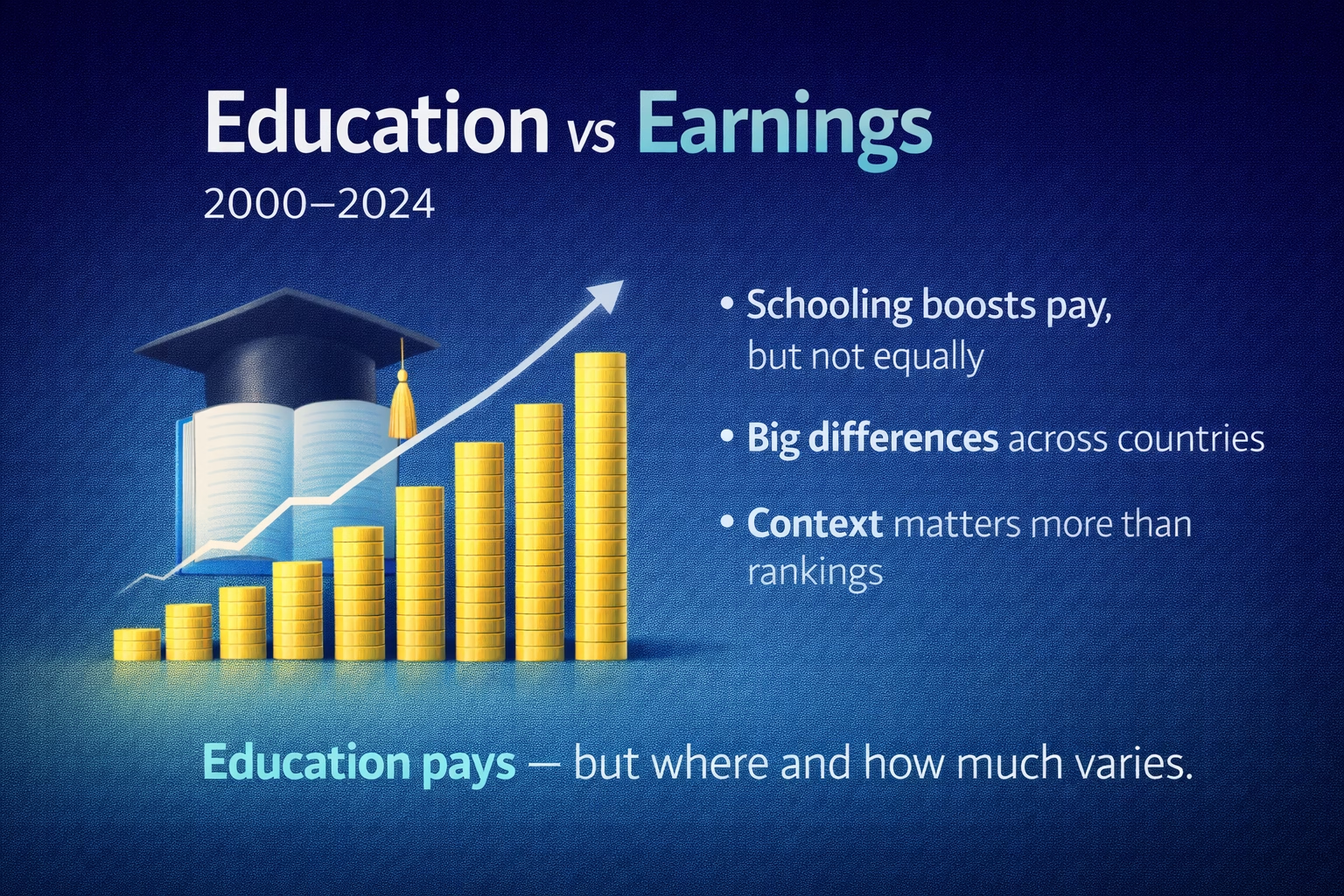
People often ask a simple question: “Is more education worth it?” The honest answer is: it depends—on the country, the level of education, the field of study, the labor market, and even the year you graduate. In some places, an extra credential is strongly rewarded; in others, the payoff is smaller because wages are compressed, public hiring is dominant, or degrees are more common than the jobs that need them. This article compares how the earnings premium associated with education differs across countries from 2000 to 2024. It explains what “returns to education” usually means in the data, why the numbers vary so much, and what can mislead readers if they treat a single ranking as a universal truth. The goal is practical: help you interpret the evidence and understand what shapes education’s value in the real economy.
AI summary
- Returns vary because labor markets vary: wage dispersion, sector mix, and skill demand can widen or compress education premiums.
- Rankings are not guarantees: method, taxes, full-time filtering, and selection effects can shift estimates across sources.
- Real payoff is multi-dimensional: net returns depend on costs, debt, and employment risk—not wages alone.
Key Visual
The headline takeaway
Education pays off in most places, but the size of the payoff varies
Across countries, higher levels of education are usually associated with higher earnings. But the size of that earnings premium is not uniform, and the reasons are rarely “education quality” alone. Wage-setting institutions, the share of high-skill jobs, the supply of graduates, and the pace of economic change can all raise or shrink the measured return.
The most useful way to read this topic is as a set of comparisons: (1) differences across countries, (2) differences across education levels (upper secondary, tertiary), and (3) differences over time as labor markets evolve. A single static ranking can be eye-catching, but it can also hide important context—like unemployment risk, underemployment, and student debt.
In this guide, we break down what the data typically measures, why it differs, and how to interpret it responsibly for career and policy decisions.
What “education returns” actually measure
A quick guide to the common definitions behind the numbers
When datasets compare “returns to education,” they are usually estimating how much earnings rise with an additional year of schooling or with a higher credential (for example, completing tertiary education versus upper secondary). The simplest versions compare average earnings by education level; more statistical approaches try to adjust for age, experience, or other characteristics.
It’s important to separate two ideas:
- Association: people with more education earn more on average.
- Causation: additional education itself is the reason earnings rise.
Many studies work hard to get closer to causation, but no single approach is perfect across all countries. That’s why the best reading is comparative and cautious: look for consistent patterns across sources, and treat small differences as noisy rather than definitive.
Why some countries show bigger payoffs
Institutions and labor market structure often matter as much as schooling
Countries can show a larger measured earnings premium for education for reasons that have little to do with classroom learning. In labor markets with wide wage dispersion, the top end of the pay scale pulls away, which can inflate the premium for degrees linked to high-paying occupations.
Other drivers include:
- Skill scarcity: when high-skill labor is scarce, employers bid up wages.
- Sector mix: economies with large high-productivity sectors pay more for specialized skills.
- Wage-setting rules: strong wage compression can shrink observed differentials.
As you compare countries, ask: is the payoff driven by strong demand for skills, or by a labor market where only a small share reaches high-paying roles?
When degrees become common, the premium can shrink
Supply, credential inflation, and the changing meaning of a degree
As tertiary attainment rises, a degree can shift from being a scarce signal to a baseline requirement. That doesn’t mean education has no value; it can mean the labor market is re-sorting, with higher competition for graduate jobs and more emphasis on field of study, work experience, and location.
Two patterns often appear in the data:
- Flattening premiums: wage differences between tertiary and upper secondary narrow.
- Rising dispersion within graduates: outcomes depend more on specialization and occupation.
This is why “average return” is only a starting point. A country may show a modest average premium while still offering very strong payoffs in specific high-demand fields.
The role of field of study and occupation
What you study can matter as much as how long you study
Cross-country comparisons often blur the single most practical detail for individuals: field of study and occupation. Two people with the same education level can face very different wage trajectories depending on whether they enter high-productivity industries, regulated professions, or crowded generalist roles.
To make country-level data more actionable, pair it with questions like:
- Which sectors are expanding domestically?
- Are there clear professional pathways (licensing, apprenticeships, residency programs)?
- Is the economy creating enough skilled jobs to absorb new graduates?
If you’re building internal resources for your site, a useful companion piece is a field-by-field breakdown. For example, you can link readers to a skills-demand explainer such as your skills content hub and an article on the cost-of-living context like cost of living since 2020.
Unemployment risk and underemployment change the story
A high premium is less helpful if jobs are scarce
Some countries show high education premiums alongside higher unemployment or underemployment among young graduates. That can happen when education expansion outpaces job creation, or when hiring is concentrated in a few cities and sectors.
For readers, a practical interpretation is: earnings premiums are only one dimension of “payoff.” A fuller view includes:
- Employment probability: how likely graduates are to find work.
- Job match quality: whether work uses acquired skills.
- Career progression: how quickly wages rise after entry.
This is also where internal links can help. You could connect readers to a labor-market piece (for example, jobs and skills) and a macro context explainer (for example, inflation and wages).
Inequality can inflate measured education premiums
Bigger wage gaps can make credentials look more valuable on paper
In more unequal economies, the distance between median and top incomes is larger. If higher education is correlated with access to top-paying roles, the measured premium can rise even if average living standards are not high. In other words, inequality can amplify the earnings gradient.
This is why it helps to read education returns alongside distribution measures. If the premium is high but the economy is polarized, the “typical” graduate experience may be very different from the top percentile story.
For external context, readers can explore distribution and education indicators in the OECD and World Bank data portals: OECD Data and World Bank Education. These sources help cross-check definitions and see how patterns change over time.
Tuition, debt, and net payoff
Gross earnings premiums are not the same as net returns
Even when education is associated with higher earnings, the net payoff depends on costs. Tuition, fees, foregone wages, and student debt repayment can change the calculus, especially for marginal programs with weaker labor market links.
A simple way to frame this is to separate:
- Gross premium: observed earnings difference by education level.
- Net return: premium minus direct and indirect costs over time.
Because cost structures vary sharply across countries, “where schooling pays off most” depends on whether you focus on wages alone or include financing and cost-of-living. If you plan a follow-up post, a tuition-and-debt comparison by country makes a strong companion piece.
How to read country rankings without fooling yourself
A checklist for interpreting cross-country return estimates
Rankings are tempting because they feel decisive. But education return estimates often differ by method, age group, and whether data is before or after taxes and transfers. The right approach is to treat rankings as a map, not a verdict.
Use this quick checklist:
- Is the comparison by education level or by years of schooling?
- Are earnings measured for full-time workers only?
- Does the data reflect pre-tax or post-tax income?
- Is the estimate sensitive to field of study and occupation mix?
When possible, cross-check with two sources and look for broad agreement. If one dataset shows a sharp outlier result, treat it as a prompt to investigate definitions rather than a headline to copy.
What changed from 2000 to 2024
Mass expansion, technology shifts, and a moving wage structure
From 2000 to 2024, many countries expanded tertiary enrollment and improved access to schooling. At the same time, technology and globalization reshaped job demand, rewarding some skills more than others. These two forces—rising graduate supply and changing skill demand—help explain why education premiums can rise in one place and flatten in another.
Broadly, you can expect to see:
- Rising attainment: more people hold degrees than in 2000.
- More specialization: fields and credentials differentiate outcomes more.
- New bottlenecks: job matching and experience requirements matter more.
The key insight: “education pays” is still generally true, but the channel is evolving. The premium increasingly depends on what skills you build and how well the labor market can absorb them.
Practical takeaways for students and policymakers
Use the data to ask better questions, not to chase a single number
If you’re a student or early-career professional, treat education-return data as a decision aid, not a promise. Start with the country-level signal, then zoom into field, region, and occupation. Where possible, favor pathways with clear labor market links and opportunities for work-integrated learning.
If you’re a policymaker, the data can highlight mismatches: too many credentials chasing too few skilled jobs, or too few trained workers in high-demand sectors. Practical levers include:
- Improving career information and placement pathways
- Aligning training with employer demand without narrowing education’s purpose
- Reducing barriers for low-income students where returns are strong
Finally, keep the story honest: a country can show a strong premium while still facing underemployment, and a smaller premium can reflect wage compression rather than low education quality. The best policy question is: what combination of education, job creation, and mobility produces broad-based opportunity?
FAQ
Quick answers to common questions.
- What does “returns to education” mean?
It usually refers to the percentage increase in earnings associated with additional schooling or a higher credential, holding other factors constant. - Does a higher return mean education causes higher pay?
Not always. Some estimates control for many factors, but unobserved ability and selection can still affect results. - Why do returns differ so much across countries?
Wage structures, labor market rules, degree supply, sector mix, and skill demand all shift the payoff. - Are university returns always higher than secondary?
Often, but not universally. In some markets, vocational pathways or scarce technical skills can pay very well. - Do field of study and occupation matter?
Yes. Earnings premiums can vary widely by major, profession, and local industry structure. - How does inequality affect education premiums?
In more unequal wage distributions, the same credential can show a larger premium even if average wages are low. - What’s the biggest mistake people make with these rankings?
Treating one country’s return as a guarantee for every student, region, or time period. - How should policymakers use this data?
As a signal about skill shortages, credential inflation, and access barriers—combined with employment and productivity data. - Where can I check the underlying data?
Use OECD Education at a Glance and World Bank education datasets to compare methods and definitions.
Hashtags
Copy-paste friendly.
#Education #Earnings #WagePremium #ReturnsToEducation #HumanCapital #LaborMarkets #Skills #Productivity #Inequality #OECD #WorldBank #Careers
Sources
Primary datasets and references.
- OECD — Education at a Glance — https://www.oecd.org/education/education-at-a-glance/
- OECD Data — Education and earnings indicators — https://data.oecd.org/
- World Bank Data — Education statistics — https://data.worldbank.org/topic/education
- World Bank Open Knowledge Repository — Education and skills research — https://openknowledge.worldbank.org/

Discover more from ThePolymathPursuit
Subscribe to get the latest posts sent to your email.
Linkvaoalo789, sounds exotic! Wonder what kinda games they got on tap over there. Might be worth a look. Go check it out yourself if you like linkvaoalo789.
iBet68us, alright! Let’s see what kinda bets they’re offering. Always on the lookout for a good wager. Give it a shot, use this link ibet68us.
Looking for some new game downloads and ran across x03gamedownload.com. If you’re after some new games: x03gamedownload
A really good blog and me back again.