
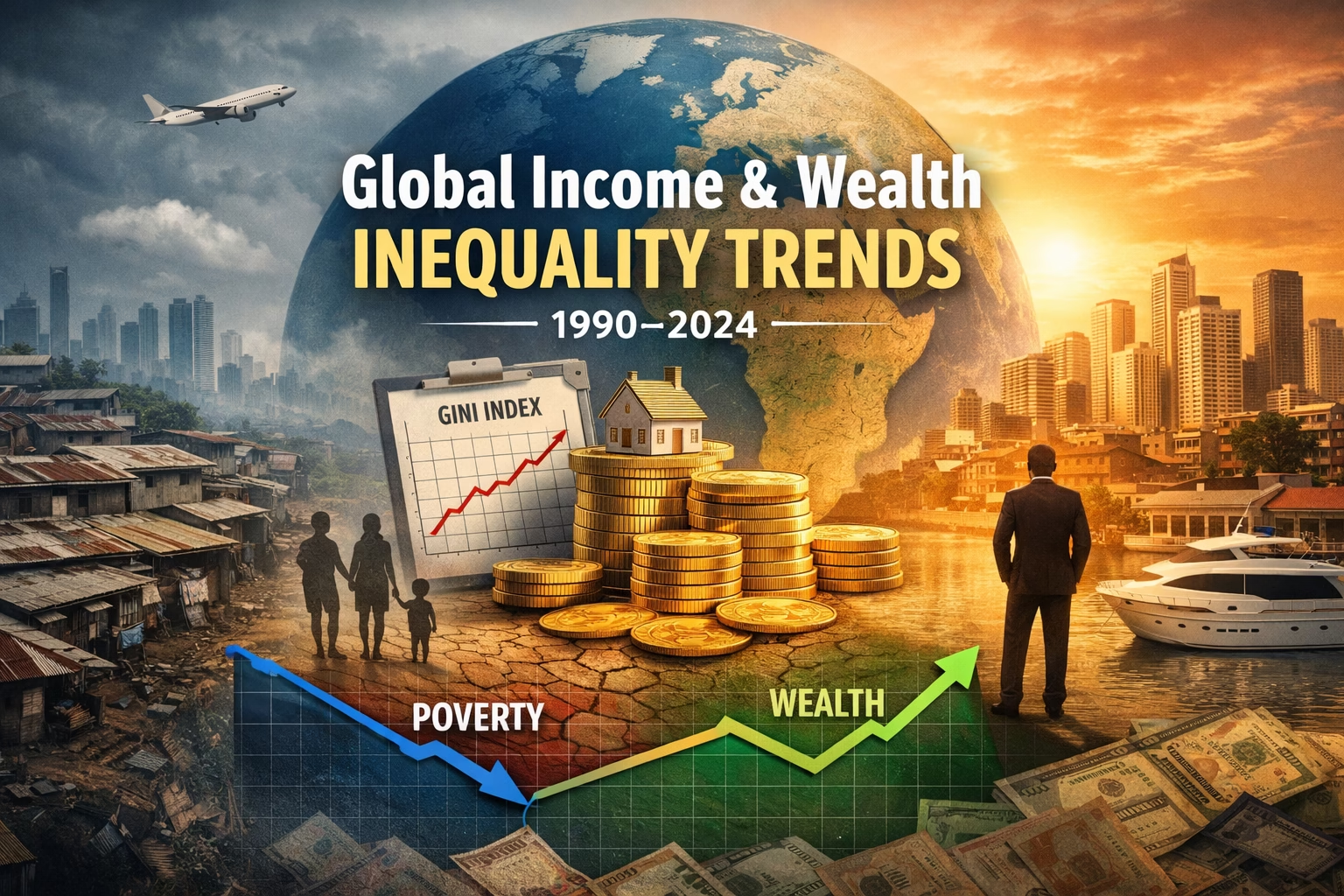
Income and wealth inequality have become central themes in economic debate, social policy, and political discourse. While global poverty has declined in many regions over the past three decades, disparities within and between countries remain significant. The distribution of income and accumulated wealth shapes opportunity, mobility, and long-term growth outcomes. Using internationally comparable datasets, this analysis examines how inequality has evolved since 1990, where gaps have narrowed, and where they have widened. It looks at GINI index trends, poverty reductions, and wealth concentration patterns to understand the structural forces behind distributional change. Rather than focusing on headlines, the goal is to identify measurable shifts and persistent divides that define the global inequality landscape today.
AI summary
- Global Shift: Between-country inequality has declined due to rapid growth in emerging economies, while within-country inequality has often increased.
- Wealth vs. Income: Wealth concentration consistently exceeds income inequality due to asset accumulation and compounding returns over time.
- Regional Variation: Trends differ sharply, with Latin America historically high but fluctuating, while OECD nations show persistent but lower gaps moderated by policy.
Chart
The global inequality picture
Long-run shifts in income distribution.
Global inequality has evolved in complex ways since 1990. Between-country inequality declined as emerging economies grew faster than advanced economies, but within-country inequality often increased.
The GINI index remains a core measure of income distribution, showing variation across regions. In parallel, wealth inequality tends to be higher than income inequality in most economies.
This dual pattern explains why global averages can improve while domestic disparities remain politically and socially sensitive.
Understanding inequality metrics
How GINI and distribution measures work.
The GINI coefficient measures inequality on a scale from 0 (perfect equality) to 100 (maximum inequality). It summarizes how evenly income is distributed across households.
Other indicators include income shares held by the top 10% or bottom 50%, and multidimensional poverty measures.
Each metric captures a different aspect of distribution. Together they provide a clearer picture of economic disparity.
Between-country convergence
Emerging economy growth effects.
Rapid growth in parts of Asia contributed to declining inequality between countries. Large populations experienced rising incomes, narrowing the gap with advanced economies.
China and India played central roles in this convergence, altering the global distribution of income.
This shift reduced global inequality at the international level, even as domestic patterns differed.
Within-country inequality
Domestic gaps and labor market change.
In many advanced economies, income inequality widened from the 1980s onward due to wage polarization, skill premiums, and capital income growth.
Technological change and globalization reshaped labor markets, benefiting high-skilled workers.
Tax and transfer systems moderated inequality in some countries, but not uniformly.
Wealth vs income gaps
Accumulation patterns over time.
Wealth inequality is typically more pronounced than income inequality because assets accumulate over generations.
Housing, equity markets, and inheritance patterns contribute to concentration at the top.
Distributional shifts in asset ownership can amplify long-term inequality dynamics.
Poverty reduction progress
Extreme poverty trends.
Extreme poverty rates declined substantially from 1990 through the mid-2010s, particularly in East Asia.
Recent shocks, including the pandemic, temporarily reversed some gains.
Long-run trends still show measurable improvement in living standards globally.
Regional inequality patterns
Latin America, Africa, OECD comparisons.
Latin America historically exhibits higher GINI coefficients than OECD economies.
Sub-Saharan Africa shows wide variation depending on resource structure and institutional development.
OECD countries generally maintain lower inequality due to redistributive systems, though gaps remain.
Policy responses
Taxation, transfers, and labor policy.
Progressive taxation and targeted transfers can reduce after-tax inequality.
Education and labor market policies influence long-term distribution outcomes.
Policy design determines whether growth translates into shared prosperity.
Global shocks and inequality
Financial crises and pandemics.
Financial crises often widen inequality through employment losses and asset volatility.
The COVID-19 pandemic affected low-income workers disproportionately in many regions.
Recovery patterns differ depending on fiscal capacity and labor structure.
Long-run structural forces
Technology and globalization.
Technological change increases demand for skilled labor and capital, influencing wage dispersion.
Globalization integrates markets, affecting income distribution across sectors.
These forces interact with national institutions to shape inequality trajectories.
What the future may hold
Distribution in a shifting economy.
Future inequality trends depend on productivity growth, policy design, and demographic change.
Digitalization and automation may alter wage structures further.
Monitoring distribution data will remain central to assessing inclusive growth.
FAQ
Quick answers to common questions.
- What is the GINI index?
A measure of income inequality ranging from 0 (equal) to 100 (unequal). - Has global inequality decreased?
Between countries it declined, but within countries it often increased. - Why is wealth inequality higher?
Assets accumulate and compound over generations. - Did poverty fall globally?
Yes, especially from 1990 to mid-2010s. - How do taxes affect inequality?
Progressive taxes and transfers can reduce post-tax gaps. - Do crises increase inequality?
Often yes, due to employment and asset shocks. - Is inequality the same everywhere?
No, it varies significantly across regions. - Why does inequality matter?
It affects mobility, opportunity, and social stability.
Hashtags
Copy-paste friendly.
#inequality #incomeinequality #wealthdistribution #gini #poverty #economicdata #globaleconomy #distribution #worldbank #ourworldindata
Sources
Primary datasets and references.

Discover more from ThePolymathPursuit
Subscribe to get the latest posts sent to your email.