
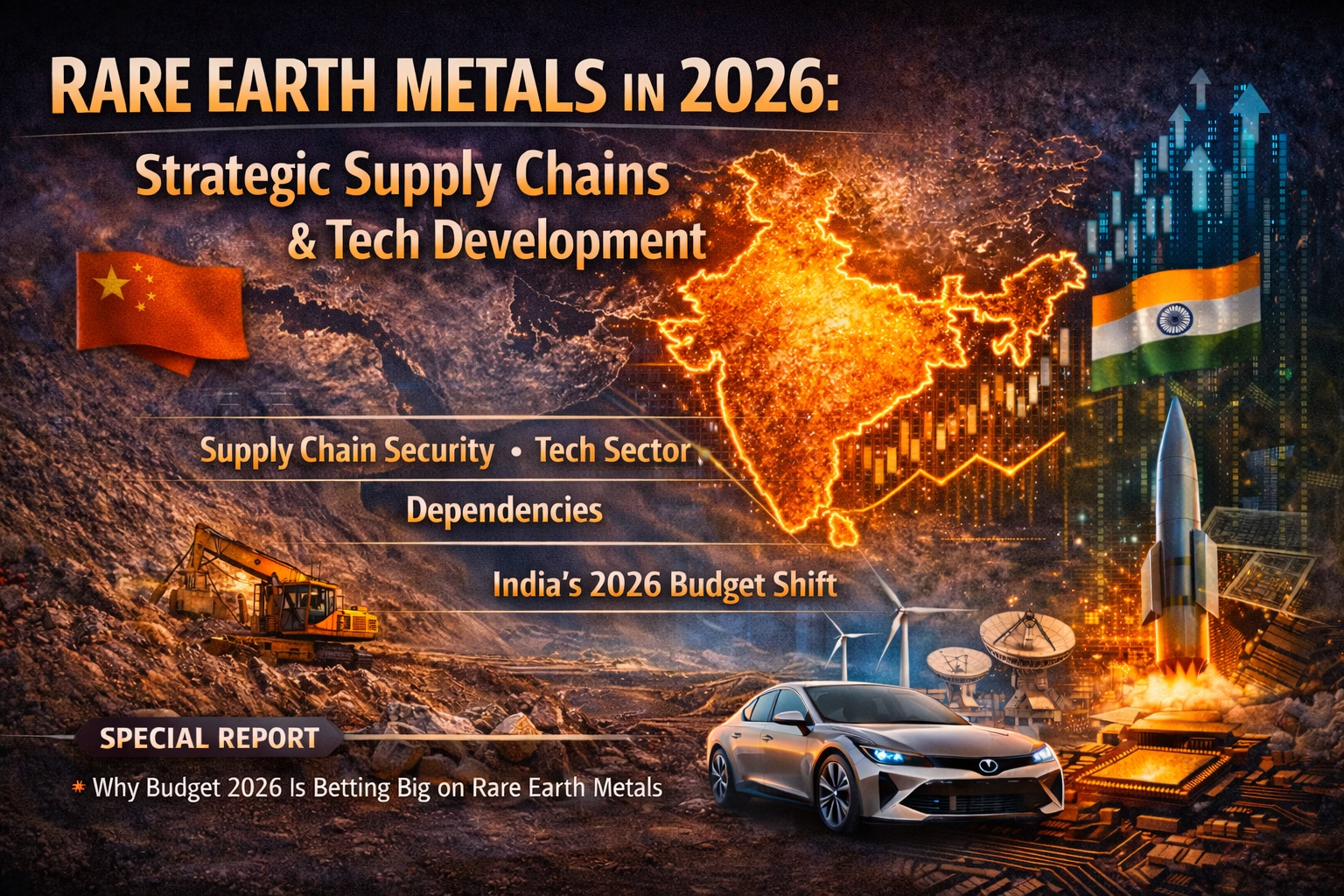
Rare earth metals in 2026: the quiet backbone of modern technology
Rare earth metals rarely make headlines on their own, yet they sit underneath some of the most important systems shaping the global economy in 2026. Electric vehicles, wind turbines, defense hardware, electronics, and advanced manufacturing all rely on a narrow set of these materials — especially when high efficiency and compact design matter.
What changed is not demand alone. Governments are now treating rare earth supply chains as strategic infrastructure. Instead of broad policy statements, budgets and industrial programs are moving toward execution: production targets, processing capacity, and manufacturing corridors.
What exactly are rare earth metals?
Rare earth metals refer to a group of 17 elements, including the lanthanides plus scandium and yttrium. In practice, supply-chain discussions focus on a smaller subset used in high-performance applications. These elements enable powerful permanent magnets, advanced alloys, and precision components.
The most economically important rare earths in 2026 are tied to magnet production. Neodymium and praseodymium, often grouped as NdPr, are essential for motors and generators where size, weight, and efficiency matter.
Why 2026 is a turning point
Rare earths have been labeled “critical” for years, but 2026 marks a shift from strategy to execution. Governments are no longer debating whether these materials matter. They are deciding where capacity should exist, how fast it should scale, and who controls the downstream value.
This shift is visible in national budgets, trade discussions, and industrial policy frameworks. The emphasis has moved beyond mining toward processing, alloying, and manufacturing capability.
The rare earth supply chain, step by step
Understanding risk starts with understanding the chain itself. Rare earth supply is not a single industry, but a sequence of tightly linked stages. A disruption at any one stage can affect the entire system.
- Mining and concentration of rare earth ores
- Chemical separation into individual oxides
- Conversion into metals and alloys
- Manufacturing of permanent magnets and components
Concentration risk is the real vulnerability
The biggest challenge in 2026 is not total global supply, but concentration. Certain stages of the rare earth supply chain remain dominated by a small number of producers. This creates exposure to policy changes, trade controls, and operational disruptions.
Even when alternative mining projects exist, downstream processing and magnet manufacturing often lag behind. That imbalance is what turns a technical material into a strategic concern.
India’s 2026 policy shift toward strategic minerals
India’s 2026 budget and policy direction reflect a broader rethinking of critical materials. Rather than focusing only on extraction, the emphasis is on building integrated supply chains. This includes processing capability, research support, and manufacturing readiness.
The logic is straightforward. Control over downstream stages creates resilience, reduces import exposure, and supports domestic manufacturing goals across automotive, energy, and defense sectors.
Why the tech sector depends on rare earth metals
Rare earth metals enable efficiency. In electric vehicles, they allow compact motors with high torque. In wind power, they support reliable generation with fewer moving parts. In defense and electronics, they enable precision under demanding conditions.
Substitutes exist in theory, but trade-offs are real. Designers often face compromises in size, weight, efficiency, or durability when rare earth magnets are removed.
What diversification actually looks like
Diversification is not a switch. It is a process. Building alternative supply chains takes time, capital, and qualification effort. In the short term, it often raises costs.
Over the long term, diversification reduces exposure to shocks and policy risk. That trade-off explains why governments and manufacturers are willing to invest now, even when markets appear stable.
Diversification in practice: where plans usually break
On paper, diversification sounds simple. Source from more countries. Add backup suppliers. Reduce dependence. In practice, rare earth supply chains tend to fail at the same pressure points.
The most common breakdown happens between mining and usable material. Separation capacity, chemical know-how, and quality control take years to mature. Even when alternative projects come online, qualification delays can limit real-world impact.
This is why many diversification efforts focus on downstream capability. A country or company that controls alloying and magnet manufacturing can absorb upstream shocks far more effectively than one that only owns ore.
How to rank countries without oversimplifying the picture
Rankings based only on mining output can be misleading. For rare earth metals, influence comes from control across multiple layers of the value chain.
A more useful framework combines several indicators. None are perfect on their own, but together they show where leverage actually sits.
- Mine production volumes and growth trends
- Proven reserves and project pipelines
- Separation and refining capacity
- Magnet manufacturing scale and quality
- Import reliance for finished components
This approach explains why some countries with modest mining output still hold disproportionate influence in global supply chains.
What this means for manufacturers and tech companies
For companies that build physical products, rare earth metals are no longer a background input. They are a strategic variable that affects design, sourcing, and long-term competitiveness.
In 2026, many firms are shifting from reactive sourcing toward planned resilience. That includes early supplier qualification, material substitution studies, and long-term contracts that prioritize continuity over spot pricing.
The goal is not to predict every disruption. It is to reduce exposure to single points of failure before they become visible in production schedules.
Why governments are intervening more directly
Governments tend to intervene when markets fail to deliver resilience on their own. Rare earth supply chains fit that pattern. High capital costs, environmental constraints, and long payback periods discourage private investment without policy support.
As a result, policy tools in 2026 go beyond trade measures. They include funding for processing plants, research programs, and incentives tied to downstream manufacturing.
These interventions aim to shift the balance from short-term efficiency toward long-term security and industrial capability.
What to watch next
The rare earth story will not resolve quickly. New capacity takes time to build, qualify, and integrate. Progress will appear uneven, with periods of calm followed by sudden stress.
The most telling signals will come from midstream investment. Announcements around separation plants, alloy production, and magnet manufacturing matter more than mine permits alone.
For both policymakers and businesses, the lesson is consistent. Rare earth metals reward early, sustained investment and punish last-minute reactions.
FAQ, hashtags, and sources
This last section keeps everything you’ll usually want at publish time in one place: quick answers, share tags, and the primary references behind the data and framing.
Further reading on The Polymath Pursuit
If you want to go one layer deeper, these two pages help connect rare earth metals to the wider critical-minerals picture.
FAQ (10+)
1) Are rare earth metals actually rare?
Not in raw abundance terms. The rarity is in cost-effective, environmentally compliant extraction and in scaling separation and manufacturing reliably.
2) What part of the rare earth supply chain is the biggest choke point?
Midstream processing. Separation into individual oxides and conversion into magnet-grade metals/alloys is complex and slow to scale compared to mining.
3) Why do rare earth metals matter so much for magnets?
High-performance permanent magnets enable compact, efficient motors and generators. That’s why EVs, wind, and robotics keep pulling on the same inputs.
4) Which datasets are best for global production and reserves?
The USGS Mineral Commodity Summaries are a widely used baseline for production and reserves: USGS rare earths summary (PDF).
5) What does the IEA add that USGS doesn’t?
USGS is strong on supply figures. The IEA adds demand scenarios, concentration risk framing, and energy-transition linkages: IEA Global Critical Minerals Outlook 2025.
6) Can EV motors avoid rare earth magnets?
Sometimes, yes. But substitution usually comes with trade-offs in efficiency, size, thermal performance, or cost. It’s engineering, not magic.
7) Why does “diversification” take so long?
Because qualification takes time. You can’t swap a magnet supply chain like a commodity bolt; specs, yields, and reliability testing make it slower than people expect.
8) Why is downstream manufacturing more strategic than mining alone?
Because downstream stages decide “usable supply.” Control over alloying and magnet manufacturing reduces exposure even when upstream supply is volatile.
9) What should manufacturers track quarterly?
Lead times for magnet-grade materials, qualification progress for second sources, and policy signals that change the economics of new capacity.
10) How is India’s 2026 approach different from older narratives?
The emphasis is shifting toward integrated chains—processing, R&D, and manufacturing readiness—rather than treating rare earths as “just a mining topic.” Official releases are typically consolidated through: PIB (Government of India).
11) Are price spikes always a sign of physical shortage?
Not always. Midstream bottlenecks for specific grades/specs can cause localized shortages even when overall supply looks adequate.
12) What’s the simplest “no regrets” move?
Start second-source qualification early and map risk by material form (oxide vs alloy vs magnet), because disruptions rarely hit all forms equally.
Hashtags (12–15)
#RareEarthMetals #CriticalMinerals #SupplyChainSecurity #StrategicMinerals #PermanentMagnets #EVSupplyChain #EnergyTransition #ManufacturingPolicy #Geopolitics #CleanTech #TechDependencies #India2026
Sources
- USGS — Mineral Commodity Summaries (Rare Earths). PDF: https://pubs.usgs.gov/periodicals/mcs2025/mcs2025-rare-earths.pdf
- IEA — Global Critical Minerals Outlook 2025: https://www.iea.org/reports/global-critical-minerals-outlook-2025
- Government of India — Press Information Bureau (primary releases hub): https://pib.gov.in

[7359]Rivalry login ph – legit gcash slots at baccarat online,Gamitin ang rivalry app download para sa mabilis na access. Mag-enjoy sa legit gcash slots online at alamin kung paano maglaro ng baccarat. Login na! visit: rivalry
[1525]poco x7 লগইন ও অ্যাপ ডাউনলোড – বিকাশ অনলাইন ক্যাসিনো,poco x7 লগইন করে রিয়েল মানি স্লট গেম এবং লাইভ ডিলার রুলেট খেলুন। বিকাশ দিয়ে অনলাইন ক্যাসিনো উপভোগ করতে আজই অ্যাপ ডাউনলোড করুন। visit: poco x7
[3273]bt222 login masuk dan daftar akaun slot online guna tng,bt222 menyediakan akses mudah untuk cara main casino live dan download apk slot mudah. Daftar sekarang untuk nikmati slot online guna tng dengan pantas. visit: bt222
[3932]789cup | Link vào trang chủ và tải app chơi nổ hũ, baccarat,789cup cung cấp link vào trang chủ chính thức để tải app, hướng dẫn cách chơi baccarat online và nạp tiền casino qua momo nhanh chóng. Truy cập và trải nghiệm ngay! visit: 789cup
[2329]Taka777 login link at legit slots na may Gcash payout,Gamitin ang taka777 login link para sa mabilis na access. I-download ang app at i-enjoy ang legit slots gcash payout at pinakamabilis na withdrawal casino. visit: taka777
Finally found an app that doesn’t lag during big wins. The bonus offers are actually fair and easy to claim. Give pkb9app a try guys, it’s a game changer.
Finally found a platform that doesn’t lag during peak hours. The interface at ph68jllogin is super intuitive and easy to navigate.
I’ve tried a few sites recently but this one is surprisingly smooth. The load times are fast and everything just works. Definitely checking out pha45com more often!
Quick withdrawals are what I care about most and this place delivers. No long waiting times or weird requirements. I trust iddtg288 for my gaming sessions.
[9755]rbaji Official Login | বিকাশ পেমেন্ট ও সেরা ক্যাসিনো বোনাস,rbaji অ্যাপ ডাউনলোড করে উপভোগ করুন সেরা স্লট গেমের নিয়ম এবং আকর্ষণীয় অনলাইন ক্যাসিনো বোনাস। বিকাশ দিয়ে সহজেই গেম খেলতে আজই জয়েন করুন। visit: rbaji
[7569]hgnice Official Login | বিকাশ ক্যাশআউট ও সেরা লাইভ ক্যাসিনো,hgnice অ্যাপ ডাউনলোড করে সেরা লাইভ ক্যাসিনো বোনাস উপভোগ করুন। বিকাশ ক্যাশআউটের সহজ সুবিধা এবং অনলাইন স্লট গেমের নিয়ম জানতে আজই লগইন করুন। visit: hgnice
[3144]mrluck88 Official Login | Best Online Slots and Fast Payouts Malaysia,mrluck88 offers a secure official login and easy app download for players. Enjoy the best online slots and fast payouts in Malaysia. Join now and start playing! visit: mrluck88
Loco777casino is kinda fun, if you’re into that crazy, high-energy vibe. Won a few bucks so far. Give it a whirl! loco777casino
Been playing on idd888 for a while now. Good selection of games and the payouts are decent. Definitely worth a look. idd888
Wassup everyone, I just wanted to share w188com with you all. Looks pretty well put together. You can check it out for yourself w188com
Just started playing on sssgame cassino! Having fun on it. The selection of games is good. You can play at: sssgame cassino
I’ve been exploring the sssgame plataforma and its offering a solid gaming experience. Good graphics and decent performance. Worth checking out if you’re looking for a new platform. Check details at: sssgame plataforma
Yo, dangkysv388 is where the real action is at! Been hitting it up lately and the odds are pretty sweet. Just signed up and already feeling lucky. Check it out! dangkysv388