
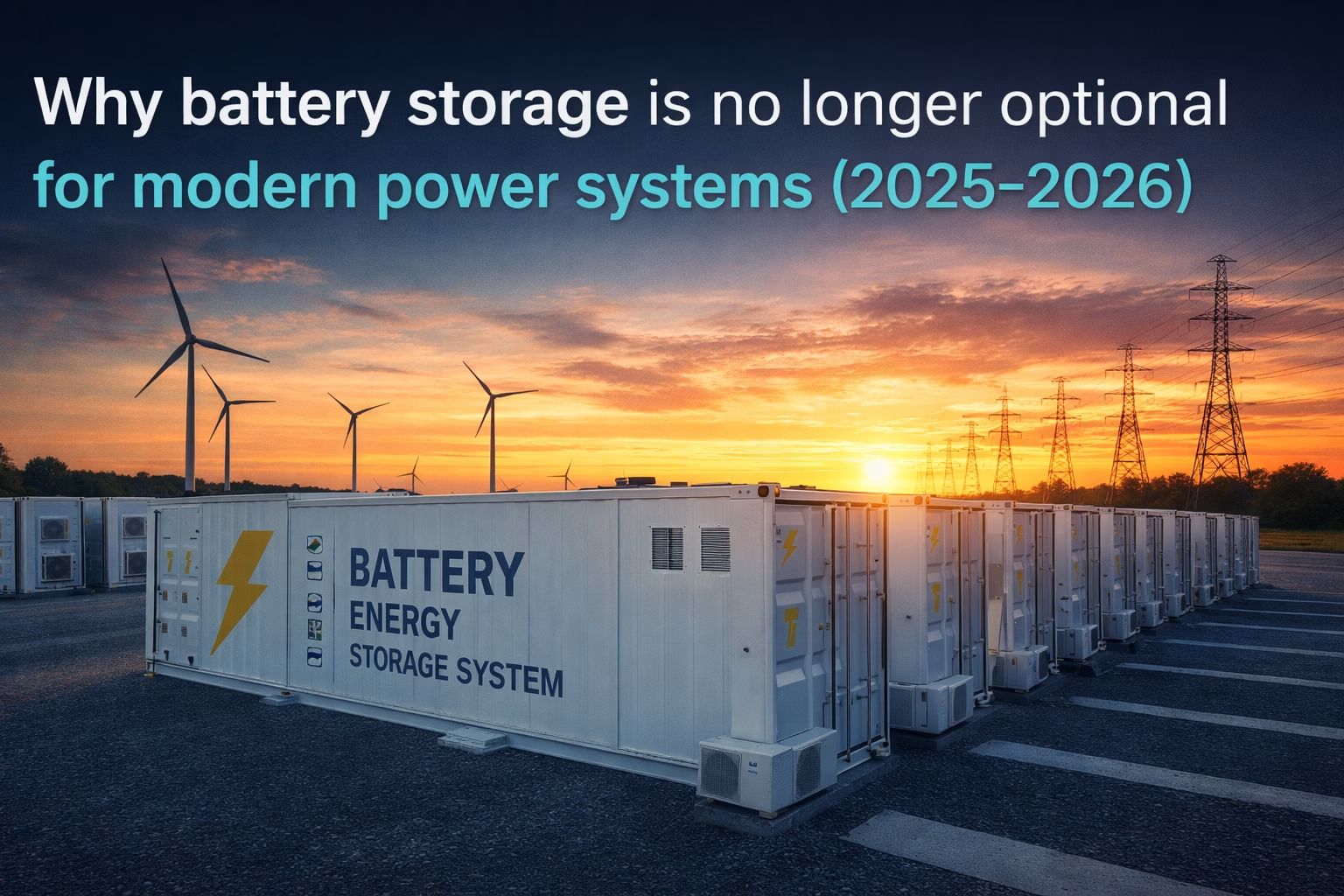
For years, battery storage was treated as a supporting technology — useful, but not essential. That perception is now outdated. By 2025–2026, grid-scale battery storage is moving into a central role as power systems absorb record levels of variable renewable energy and face tighter reliability constraints. Annual deployments are crossing the 100-gigawatt threshold, and falling costs plus faster build times are making batteries competitive with traditional peaking plants in more markets than ever.
AI summary
Why this matters now: The storage boom isn’t just more projects—it’s a change in grid planning. As wind and solar shares rise and reliability constraints tighten, batteries move from “helpful” to “system-critical.”
What’s driving it: annual installs are scaling into triple-digit gigawatts, build times are short, and economics improved at the same time reliability needs rose. Revenue stacking also makes projects easier to finance.
How to track reality vs hype: follow installed GW and GWh together, watch cost trends and duration mix, and pay attention to capacity accreditation rules and curtailment in high-renewable regions.
Key Visual
Summary
The shift from “nice-to-have” to system-critical.
Snippet: Grid-scale battery storage is hitting a turning point in 2025–2026 as deployments surge past 100 GW per year, costs fall sharply, and grids increasingly rely on storage for reliability and renewable integration.
What changed: Storage economics improved at the same time that grid reliability needs rose (renewable variability, rising demand, and extreme weather). Storage is now planned like a system pillar, not a pilot.
- Scale: annual installs moving into triple-digit gigawatts.
- Speed: projects permit and build faster than most conventional generation.
- Revenue stacking: cashflows increasingly come from multiple markets (energy, capacity, ancillary services).
Related reads on this site: energy prices & cost of living since 2020, rare earth metals in 2026, and home prices vs incomes (2010–2026).
Why 2025–2026 is a turning point
Why this growth cycle is different from earlier booms.
Several forces are converging at once. Renewable generation is growing faster than grid flexibility, electricity demand is rising again after years of stagnation, and extreme weather events are exposing the limits of legacy infrastructure. Battery storage sits at the intersection of all three pressures.
What makes this moment different from earlier “storage booms” is scale. Past growth cycles were impressive in percentage terms but small in absolute capacity. Crossing into triple-digit gigawatt annual deployments pushes storage into the same planning category as generation and transmission — not a pilot project, but a system pillar.
Grid operators are also gaining operational confidence. After thousands of projects have been built and dispatched, storage performance is now predictable enough to be written directly into capacity markets, resource adequacy models, and reliability standards.
How fast grid-scale storage is growing
From policy pilots to market-driven infrastructure.
Global deployment data shows a sharp acceleration beginning in the early 2020s and steepening again as projects move from policy-driven pilots to market-driven infrastructure investments.
- Build speed matters: in leading markets, battery projects are being permitted and built in a fraction of the time required for conventional generation.
- Flexibility advantage: storage can respond to demand growth, renewable buildouts, and grid congestion faster than almost any other large-scale asset.
- Feedback loop: as more storage comes online, planners rely on it more heavily, which in turn attracts further investment.
If you track only one thing, watch annual installed GW and GWh together — power and duration tell different stories.
The economics behind the surge
Why batteries are winning short-duration flexibility.
Cost dynamics are the quiet engine behind the storage boom. While headlines often focus on deployment volumes, the real story is that grid-scale batteries have crossed multiple economic thresholds at once. Capital costs have fallen, performance has improved, and revenue stacking has become more predictable.
According to cost benchmarks from the U.S. National Renewable Energy Laboratory (NREL), the total installed cost of utility-scale lithium-ion battery systems has dropped dramatically over the past decade. Even with recent supply chain volatility, long-term learning curves remain intact.
More importantly, batteries now compete directly with traditional peaker plants on a levelized cost basis in many regions. For short-duration flexibility — the kind required to manage daily solar and wind variability — storage often delivers the same service at lower risk and faster deployment.
Revenue stacking and investor risk
Multiple revenue streams make projects bankable.
What changed: Battery projects earn revenue from multiple streams at once: energy arbitrage, capacity payments, ancillary services, and increasingly from avoided grid upgrade costs.
This ability to stack revenues reduces downside risk. Investors are no longer betting on a single price signal. Instead, storage assets participate across several market layers, making cash flows more resilient than in earlier development cycles.
- energy arbitrage
- capacity payments
- ancillary services (frequency regulation, reserves)
- and, in some cases, grid upgrade deferral value
From backup asset to core infrastructure
Operational value: speed, stability, and contingencies.
In early deployments, battery storage was framed as a “nice-to-have” — something that could smooth renewable output at the margin. That framing no longer fits reality. As penetration of wind and solar rises, storage increasingly determines whether new generation can connect at all.
Grid operators now rely on batteries to perform tasks once reserved for large, centralized power plants. These include frequency regulation, fast ramping, voltage support, and contingency response during outages.
System insight: Storage does not just follow renewables — it enables them. Without sufficient storage, high-renewable grids become brittle.
Policy, markets, and why deployment accelerates
Rules and eligibility can change economics overnight.
Policy frameworks are finally catching up with technical reality. In many markets, capacity mechanisms, reliability standards, and grid codes have been updated to recognize storage as a distinct asset class, rather than forcing it into generation or load categories.
This matters because eligibility determines revenue. Once batteries qualify for capacity payments or ancillary service markets on equal footing, project economics improve almost overnight.
At the same time, permitting timelines favor storage. Compared with new transmission or thermal generation, battery projects face fewer siting conflicts and can be deployed incrementally.
The International Energy Agency (IEA) has repeatedly highlighted that storage is one of the fastest levers available to improve grid reliability over the next five years — faster, in many cases, than expanding transmission networks.
What storage can — and cannot — solve
Where lithium-ion excels — and where it doesn’t.
Despite rapid progress, storage is not a universal solution. Short-duration batteries excel at managing hourly variability, but they are not designed to cover multi-day or seasonal gaps. That distinction is often blurred in public discussion.
As a result, grids with very high renewable shares still require complementary solutions: expanded transmission, flexible demand, longer-duration storage technologies, or firm low-carbon generation.
Reality check: Battery storage is transformative, but only when integrated into a broader grid strategy.
Metrics to watch in 2026
A short dashboard for readers and analysts.
What to track: If you want to understand this boom without getting lost in hype, focus on a small set of indicators.
- annual installed GW and GWh (power and energy)
- installed cost trends ($/kW and $/kWh)
- duration mix (2h vs 4h vs 8h+)
- capacity market participation and accreditation rules
- curtailment levels in high-renewable regions
These metrics show whether storage is solving real constraints (congestion, peaks, reserves) or simply following incentives.
Key visual (16:9) and interpretation
Use one image to explain the turning point.
grid-scale battery storage boom 2025–2026 — costs, deployment, and grid reliability
This section is intentionally simple: choose one strong chart or infographic that explains the “turning point” in one glance (deployments, costs, or reliability value).
Bottom line
The simplest way to explain why this matters.
If you remember one thing, it’s this: storage makes the grid flexible, and flexibility is what turns renewable generation from “available sometimes” into reliable power when needed.
- For readers: watch deployment scale and duration mix.
- For builders: interconnection and grid upgrades often gate speed more than batteries themselves.
- For policymakers: market rules that recognize storage as an asset class change economics fast.
Use the FAQ below as a quick reference, then check the sources for primary datasets and benchmarks.
FAQ
Quick answers to common questions.
- What is grid-scale battery storage?
Grid-scale storage refers to large batteries connected to the power system that charge and discharge to support reliability, balance supply and demand, and integrate renewables. - Why is 2025–2026 described as a turning point?
Deployment volumes are crossing a scale where storage becomes a core planning asset, not a pilot. Improving economics also make it competitive for short-duration flexibility. - What does “100 GW+ annual installs” actually mean?
It indicates global yearly deployment is reaching triple-digit gigawatts of new storage capacity, a threshold that changes market depth, supply chains, and grid operations. - What is the main job batteries do on the grid?
They shift energy in time, respond quickly to imbalances, and provide services like frequency regulation and reserve power during peaks. - Are batteries replacing gas peaker plants?
In many markets, batteries increasingly compete with peakers for short-duration peak support. They don’t replace every peaker use case, but the overlap is growing. - What is “revenue stacking” for storage projects?
It means batteries earn money from multiple services: energy arbitrage, ancillary services, capacity payments, and sometimes grid upgrade deferral value. - What can’t typical lithium-ion storage solve?
It is excellent for hours-scale flexibility but not designed for multi-day or seasonal gaps without complementary long-duration solutions. - Why do grids need storage for renewables integration?
Wind and solar output varies; storage smooths those swings and helps keep supply stable during ramps and peaks. - What is the biggest bottleneck for scaling storage faster?
Interconnection queues, permitting timelines in some regions, supply constraints for certain components, and grid upgrade delays often matter as much as battery costs. - What metrics should readers track to understand the boom?
Annual installed GW/GWh, installed cost trends, duration mix, capacity market participation, and curtailment levels in high-renewable grids. - Does storage lower electricity prices?
It can reduce price spikes and improve reliability, but impacts vary by market design, congestion, and generation mix. - What is the simplest way to explain why this matters?
Storage makes the grid more flexible. Flexibility is what turns renewable generation from “available sometimes” into “reliable power when needed.”
Hashtags
Copy-paste friendly.
#BatteryStorage #GridScaleStorage #EnergyStorage #RenewablesIntegration #GridReliability #CleanEnergy #PowerGrid #EnergyTransition #StorageCosts #SolarAndWind #CapacityMarkets #ElectricityDemand #Flexibility
Sources
Primary datasets and references.
- Wood Mackenzie — storage market milestone (100 GW annual installs): https://www.woodmac.com/news/opinion/global-energy-storage-market-surpasses-100-gw-annual-installation-milestone-in-2025/
- NREL — battery storage cost and performance benchmarks (PDF): https://docs.nrel.gov/docs/fy25osti/93281.pdf
- IEA — Electricity Mid-Year Update 2025 (2025–2026 demand growth context): https://www.iea.org/reports/electricity-mid-year-update-2025/demand-global-electricity-use-to-grow-strongly-in-2025-and-2026

Spinning has never been this easy on my phone. The interface is super clean and I get my payouts in no time. Really appreciate how fair everything feels compared to other apps on the market. ezspin4
[7481]jita লগইন এবং অ্যাপ ডাউনলোড | বিকাশ দিয়ে স্লট গেম খেলুন,jita লগইন করুন এবং সহজেই অ্যাপ ডাউনলোড করে নিন। বিকাশ দিয়ে অনলাইন ক্যাসিনো গেম খেলুন ও অনলাইন রুলেট খেলার নিয়ম জেনে আজই জয়েন করুন। visit: jita
[6164]1xbet লগইন ও অ্যাপ ডাউনলোড | বিকাশ দিয়ে ক্যাসিনো ডিপোজিট,1xbet লগইন করে অনলাইন স্লট গেম খেলার নিয়ম জানুন এবং লাইভ ক্যাসিনো বোনাস অফার লুফে নিন। এখনই অ্যাপটি ডাউনলোড করে গেম শুরু করুন। visit: 1xbet
[5793]sv38 | Link vào sv38 và hướng dẫn chơi baccarat online,sv38 cung cấp link vào chính thức, hỗ trợ tải app sv38 nhanh chóng. Tìm hiểu cách nạp tiền casino qua momo và hướng dẫn chơi slots nổ hũ chi tiết tại đây. visit: sv38
I have been looking for a reliable slot app for months and finally found something that actually works smoothly on my phone. The graphics are crisp and the bonus rounds keep me coming back for more every single evening. If you want a stress free gaming experience without unnecessary ads this is definitely the spot to start playing today. evo33apk
If you are looking for a real solution to win more often, this is the place. The tips and the platform are top notch. idsolusiwin is a hidden gem.
[1590]9gbet Official Login | বাংলাদেশে সেরা অনলাইন ক্যাসিনো ও স্লট গেম,9gbet এ লগইন করে উপভোগ করুন সেরা অনলাইন স্লট গেম। বিকাশ পেমেন্ট সুবিধা এবং রুলেটের সহজ নিয়মসহ আজই অ্যাপটি ডাউনলোড করে খেলা শুরু করুন। visit: 9gbet
Super easy registration process and the customer support team is actually helpful. It is rare to find a site this user friendly. Give bdbtd88 a try.
[7373]bosdeal88: Login Resmi Link Alternatif Slot Gacor Terpercaya,bosdeal88 menyediakan akses judi casino online terpercaya dengan pilihan slot gacor hari ini. Nikmati kemudahan deposit pulsa tanpa potongan. Daftar sekarang juga! visit: bosdeal88
[2300]4777bat Official Login | সেরা অনলাইন স্লট ও ক্যাসিনো গেমস,4777bat-এ লগইন করে উপভোগ করুন সেরা অনলাইন স্লট ও ক্রাশ গেম। বিকাশ দিয়ে সহজ ডিপোজিট এবং অ্যাপ ডাউনলোড করে আজই খেলা শুরু করুন। visit: 4777bat
Downloaded the app and it runs perfectly on my phone. The installation was straightforward and the graphics are crisp. Head over to pak98gamedownload for the best version.
Really impressed with the bonus offers here. It gives new players a great head start. I am having a lot of fun on ph61jl and I plan to stay for a long time.
Honestly one of the most honest platforms I have used. No hidden fees and the bonuses are actually fair. Big thanks to idrp66 for the great service.
Anyone playing on TA88? Thinking of signing up. Is ta88vips worth the time and money, or should I stick to what I know?
Looking for a reliable place to follow 7m.cn ma cao? I stumbled upon this one and it’s been working well for me. You might like it! 7m.cn ma cao
Need the ‘kết quả 7m ma cao’? I get all my results from this site. It’s my go-to place after every match. Such a great resource! kết quả 7m ma cao.